Tank Assembly Labor
M Built Tanks provides subcontracted crews for the field assembly of factory-coated bolted steel flat-panel tanks. Our workers carry out defined tasks according to approved drawings, specifications, procedures, schedules, and site requirements supplied by the contracting party.
Assigned Assembly Tasks
On-Site Tank Assembly
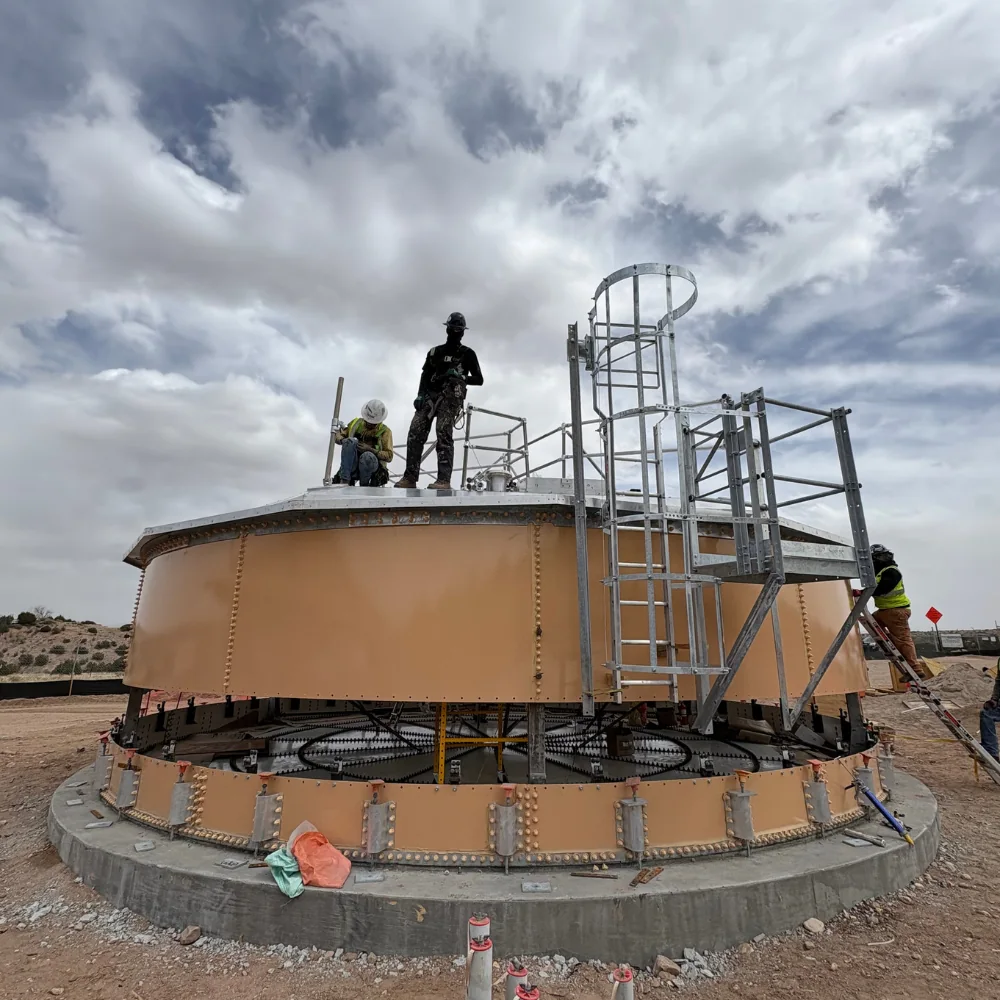
Hands-on work involving the positioning, alignment, sealing, and bolting of supplied factory-coated steel panels and related tank components.
Crew Leadership
Leadership and supervision of M Built Tanks’ own workers, with attention to sequencing, communication, and the responsibilities defined in the subcontract.
Field Support
Material staging, component handling, equipment operation, and other assembly activities included in the written scope.
Crew Experience Range
5,000 to 3,000,000 Gallons
Approximate tank-capacity range represented in crew experience.
Up to Approximately 80 Feet Tall
Approximate tank height represented in crew experience.
Approximately 10 to 160 Feet in Diameter
Approximate tank-diameter range represented in crew experience.
Subcontracted Labor Scope
M Built Tanks provides labor for defined tank-assembly work.
Engineering, tank design, CAD drawings, manufacturing, materials, coating specifications, project management, overall site supervision, inspections, certification, and responsibility for the complete tank system remain with the contracting party and other designated project participants.
M Built Tanks may lead and supervise its own crew but does not assume overall project or site-supervision responsibility unless expressly included in the written subcontract.
Tank Assembly Labor Questions
The tank shell is formed from factory-coated steel panels. Crews position and align the panels, apply the specified sealant or gasket system, and install the required bolted connections according to approved documents and manufacturer instructions.
Depending on the approved method, shell rings may be assembled progressively using cranes, lifts, or a hydraulic jacking system.
The panels are manufactured as part of a factory-coated bolted system. Bolted connections allow the supplied panels to be joined in the field without treating the shell as a conventional field-welded tank.
Separate components may use other approved installation methods when required by the design and manufacturer instructions.
Before assembly begins, the crew may organize the staging area, review approved documents, confirm equipment access, verify material delivery, inspect supplied components for visible handling concerns, and coordinate with the project team regarding site conditions and schedule.
This preparation is not engineering acceptance of the foundation, design, or materials.
Equipment may include cranes, hydraulic jacks, aerial lifts, rough-terrain forklifts, skid steers, scissor lifts, boom-supported work platforms, hand tools, and power tools.
The equipment plan depends on the tank dimensions, approved assembly method, site access, lifting requirements, and project safety plan.
Depending on the approved scope, remaining work may include roof or dome installation, access ladders, platforms, handrails, specified fittings, exterior components, final bolt checks, cleanup, and coordination for the next project phase.
Formal testing, manufacturer acceptance, engineering review, and owner turnover are handled according to the project documents.